
Reinventing injury recovery with 3D prints
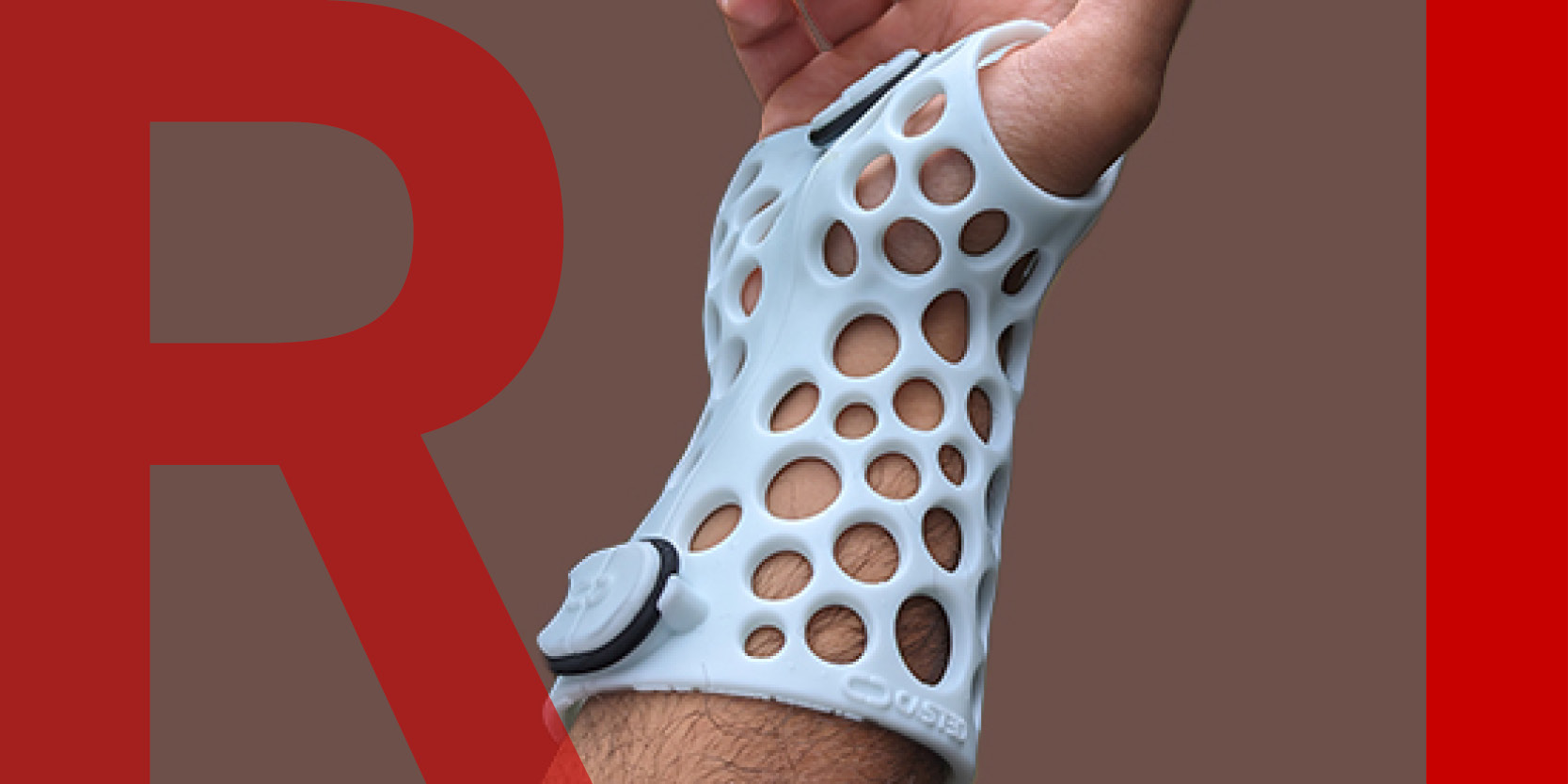
After surviving a serious accident, engineer Gaurav Chauhan faced a painful recovery in uncomfortable traditional casts. This experience inspired him and his colleague, Ali Abdi, to reimagine orthopaedic casts using 3D printing. Together, they founded CAST3D, aiming to create comfortable, customised splints, particularly for stroke survivors who often find standard splints unusable.
The University of Leeds played a crucial role in bringing this idea to life, connecting them to experts through its Nexus hub, helping them secure grants, and supporting clinical trials with Leeds Teaching Hospitals NHS Trust.
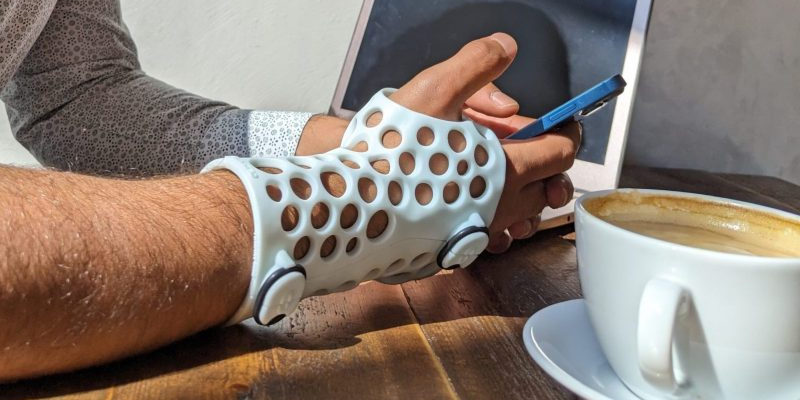
CAST3D’s innovative wrist splints promise better patient comfort, reduced infection risk and potential cost savings for healthcare systems.
Key information
- Major Funders: Innovate UK
- Partners and collaborators: Nexus Leeds, Leeds Teaching Hospitals NHS Trust
- Disciplines: design, healthcare, medicine, mechanical engineering
- Investigators: Gaurav Chauhan, Alireza Abdi, Chris Walshaw, Professor Rory O’Connor.
When the car came to a standstill, it wasn’t clear whether the man inside was alive or dead. Fortunately, Gaurav Chauhan survived the serious accident in his native India back in 2017.
But recovering from it? That would take time – lots of it.
“I remember calling him on Teams several months later,” colleague Alireza Abdi said.
“He was sitting upright in his chair with a full cast over his body, unable to move or eat; it was agonising to see.”
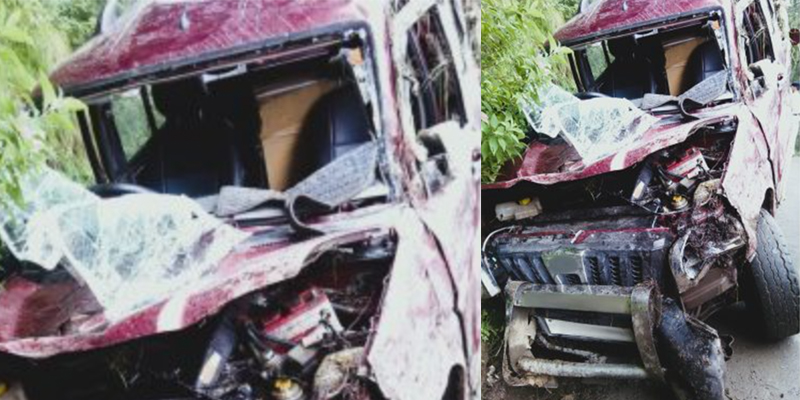
Photograph of the car Gaurav was travelling in after the crash.
Among Gaurav’s many injuries was a fracture in his neck, which necessitated a painful, lengthy rehabilitation period spent in plaster casts and splints.
From this torturous experience, the friends gained a new perspective on traditional orthopaedic casts and their shortcomings.
“Gaurav complained that it was uncomfortable, sweaty, itchy and dirty,” Alireza explained.
“Casts were something I’d never given a second thought to until that point, when we began to learn that they can be unhygienic and cause infections or skin rashes, for example.”
Today, as co-founders of a startup called CAST3D, the subject is never far from Ali’s mind.
Through their young company, CAST3D, he, Gaurav and colleagues are seeking to achieve just that, thanks in no small part to early assistance provided by the University of Leeds and its collaboration and innovation hub, Nexus.
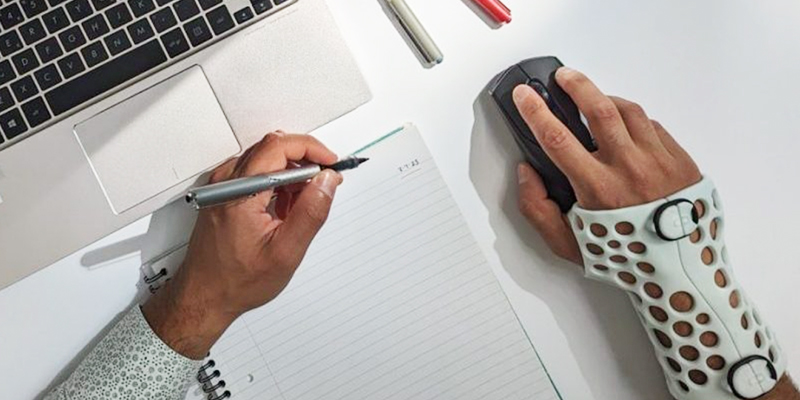
“Nexus has helped us apply successfully for an Innovate UK grant that will cover the costs of our upcoming clinical trial and community engagement work,” Ali said.
“And thanks to the doors our membership has opened for us, we’re working with Leeds Teaching Hospitals NHS Trust and the University to deliver the trials and generate results that we can hopefully then take to the NHS and the private healthcare sector to demonstrate the impact.”
Age-old methods, meet pioneering tech
Splints have been used to help fractures heal since at least Ancient Egyptian times, with casts made from gypsum plaster – otherwise known as plaster of Paris – first tested in the early 19th century.
The techniques and materials involved may have been refined over the years, but the general approach has remained largely unchanged.
But engineers like Ali and Gaurav have a habit of asking ‘what if?’, and their roles at Leeds-based 3D printing company Additive Design meant it was only a matter of time before their inquisitive minds would look at plaster casts in a different light.
“I studied for a MEng in Aerospace and Aeronautical Engineering at the University of Leeds, which gave me the passion, knowledge and networks you need to move into the engineering industry.
“A few years later, I worked at Johnson & Johnson on the world’s first customised hip implant,” Ali said.
“They require a lot of design and engineering time, involve a CT scan of the patient’s body and are very expensive to produce, but my experiences there led me to think about how we could improve orthopaedic casting with a similar principle of customisation.
“It was exciting because if we could get it right, there would be all manner of benefits to patients.
“Not only could technology make their time spent recovering more comfortable, but it could also reduce it because manually set plaster casts can involve positioning or other errors that mean bones don’t heal properly.”
Initiative and collaboration
The idea was sound, but turning the concept to a tangible reality was a unique challenge for the pair.
“Things were a bit crude in the early days; I remember using an Xbox controller while making a 3D scan of my hand, for instance,” Ali said.
Nevertheless, the pair managed to produce a prototype – even if Ali recalls that it “barely fit”.
To get any sort of traction, Ali and Gaurav needed to demonstrate their progress to gain trust from within the medical industry.
“We took the plunge, went to London and managed to show our device to a hand surgeon, who thankfully was very impressed,” Ali said.
“He saw that we had the germ of something, but still, we had to determine how our idea could scale up and overcome some pretty daunting technical challenges.”
One such hurdle, in fact, led the engineers to redefine their project entirely.
Recognising that current 3D technology limitations make it impossible to print a customised cast within the one or two-hour timeframe required when someone fractures a limb, Chauhan and Abdi decided to narrow down the use case of their product.
And as ‘virtual’ members of Nexus, the collaboration and innovation hub at the University of Leeds, the duo could access expert support to help them find a new way forward.
“We explained what we wanted to do to the University, and the Nexus team connected us to Rory O’Connor, Chartered Professor of Rehabilitation Medicine,” Ali said.
This link would prove to be a game-changer for Ali and Gaurav.
As the lead clinician for rehabilitation at Leeds Teaching Hospitals NHS Trust, not to mention Director of Research and Innovation at the Leeds Institute of Rheumatic and Musculoskeletal Medicine, Professor O’Connor had decades of wisdom and first-hand experience with patients to share with the CAST3D team.
“Rory’s main area of research is rehabilitation technology development – exactly the kind of thing that we were getting stuck into – so the fact that Nexus could bring us together meant we suddenly had a world expert working alongside us,” Ali said.
“Our original idea had been to look at carpal tunnel syndrome, where pressure on a nerve in the wrist causes pain and numbness.
“Rory explained that actually, the existing splints were fine for that – but that stroke patients would be a perfect user group for our technology.”

A focus on impact
Every year, around 100,000 people have strokes in the UK.
More than 1.3 million survivors are often left with disabilities, and many wear splints for anywhere from six months to up to two years while recovering.
“We realised that the existing solution for stroke patients is very poor,” Ali said.
“Thanks to Rory’s connections, we actually surveyed clinicians and patients themselves, with many of them telling us that the splints were so uncomfortable they didn’t even wear them.”
Given strokes are estimated to cost the NHS around £3 billion every year, revolutionising the splint could have huge economic advantages as well as giving patients a better quality of life.

Improved experiences, reduced costs
Of course, CAST3D is far from the only business looking to harness the power and speed of 3D printing for medical purposes.
“There are companies in the US and Europe that are working on orthopaedic casts too,” Ali said.
“But I do think what we are doing is unique, because we’re focusing on just one part of the human anatomy: the wrist.
“It’s one of the most frequently broken bones in the body, and instead of trying to develop customised casts for all types of fracture, honing down to a single area allows us to overcome specific challenges more quickly with our clinical partners.”
Hopes are high should the trials go well.
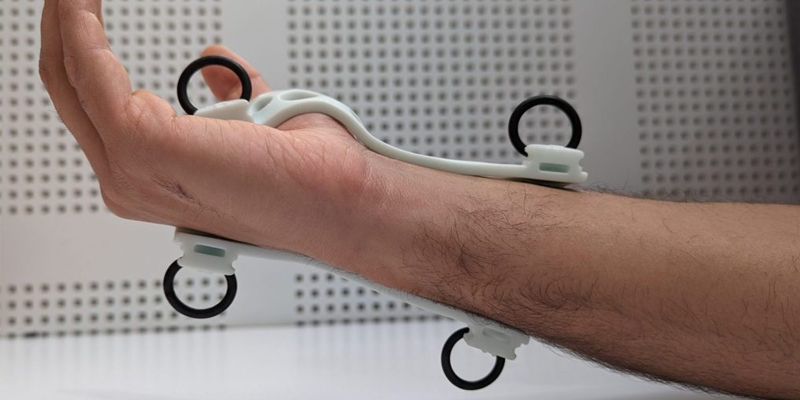
Wrist splints that can be produced cost-effectively and at scale would provide future patients in hospital or at home with devices that are more breathable, cleanable and comfortable than existing solutions.
That could also reduce the risk of infection and make monitoring the healing process visually far easier, saving medical professionals time and resources.
Some intriguing side benefits are within reach, too.
“We’re looking at offering different colours of our devices to make them more visually appealing than people are used to and, crucially, more likely to be worn as a result,” Ali said.
“Children and adults alike would then be able to display their splints with pride as a reflection of their personality.”
For now, the team are busy working on the trials of their lightweight, waterproof, washable devices.
And should results prove positive, perhaps one day recoveries like Gaurav’s will be that much less agonising.