
Plugging the translational gap to advance 3D printing
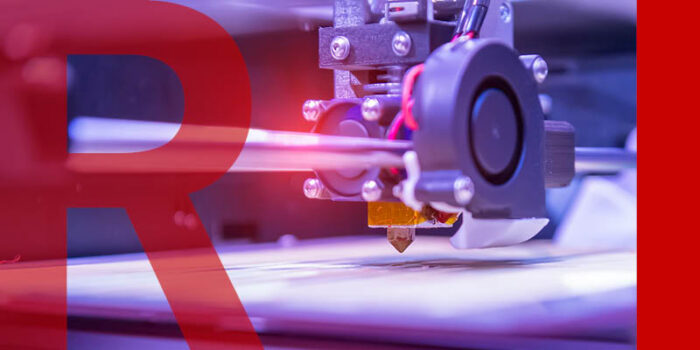
As the market for 3D printing grows, manufacturers are gaining new abilities to engineer higher-quality, bespoke products more efficiently and at lower cost. This advanced form of computer-controlled digital machinery is increasingly powering the rapid production of eyewear and electronics, automotive components and industrial prototypes.
While printing techniques for polymer and metal-based products are well established, the ability to engineer ceramic-based products lags behind, limiting the widespread adoption of 3D printing of ceramics.
Research to innovate new forms of 3D printing for ceramic materials has been underway at the University of Leeds since 2014. Thanks to strong industry collaborations and Impact Acceleration Account (IAA) funding from the Engineering and Physical Sciences Research Council, the university’s knowledge and expertise in this space are being applied to create a commercially viable 3D printing process for ceramics-based components.
Impact
- Knowledge discovery: developed a fully operational machine to produce high-quality 3D-printed ceramics
- Collaboration with industry to create real-world manufacturing solutions, resulting in a successful spinout company.
Key information
- Major funders: Engineering and Physical Sciences Research Council (EPSRC) Impact Acceleration Account (IAA)
- Partners and collaborators: National Physical Laboratory
- Disciplines: advanced manufacturing, mechanical engineering
- Investigators: Professor Robert Kay.
Industry-academic collaboration
“I get a kick out of the translational side,” says Robert Kay, Professor in Advanced Manufacturing at the University of Leeds School of Mechanical Engineering. Professor Kay leads work to translate the group’s hybrid 3D printing concept for ceramics from their academic environment into a fully operational manufacturing process.
“Industry has really struggled to adopt 3D printing for ceramics because of the limitations of the current technology, so we worked with our commercial partner to apply our scientific knowledge and build a machine from the ground up,” he explains.
“The IAA funding has meant that we can combine our resources and expertise with industry support to demonstrate our unique concept for this advanced form of manufacturing. The outcome is that we’ve built a machine that’s now working away in our collaborator’s factory to produce high-quality ceramic components.”
Extremely hard, chemically inert, and resistant to high temperatures, ceramics have a growing list of applications in biomedical prosthetics, turbine blades, superconductors, chemical reactors and aerospace engineering. Despite demand, the UK lacks experienced machine builders to develop, upgrade and refine manufacturing processes to handle these complex materials.
To tackle the challenge of producing dense ceramic material using existing additives and materials, Professor Kay’s team developed a hybrid 3D printing technique that combines several processes, a tool changer and multiple process heads in one machine. Their industry collaborator provided materials, secondary processing, polishing and density testing of the samples produced, along with technical guidance and support.
“These sorts of research partnerships mean you can keep your work relevant, so it's useful in the real world and economically viable,” says Professor Kay. “The company we worked with makes ceramics-based products and components and wanted to modernise their manufacturing processes, so with us bringing expertise to develop and build new machinery, it was a synergistic partnership that meant we could retain intellectual property (IP) on the technology.”
Advancing machinery across West Yorkshire
With their machine now fully operational, the team at Leeds provide ongoing support and upgrades and has regular meetings with their collaborator to understand how it performs day-to-day - rich insights that feed into the continued refinement of their IP.
Developing and demonstrating their technology, and creating a business case for commercial scale-up as part of the IAA phase of the project was the team’s crucial first step towards winning their second grant. Part of a bid led by the National Physical Laboratory, they were awarded a share of the £22.6 million Strength in Places Fund, a key initiative of the UK Government’s strategy to boost innovation of advanced machinery across West Yorkshire and Greater Manchester.
With IP and funding secured, Professor Kay and colleagues took the next leap – spinning out Hydra Manufacturing Ltd. The company achieved its first sale just one week after spinning out, catapulting the team into an advantageous position. With grant funding, a proven product, multiple industry relationships and a sales pipeline, the company isn’t necessarily dependent on the backing of private investors to scale and grow, a hurdle many spinouts struggle with.
The team at Hydra Manufacturing is now planning to showcase their technology to a broad range of potential adopters across the industry and to establish operations in a dedicated factory space outside the university setting.
Professor Kay said: “We’re fortunate to already have grant funding under our belt and a product ready to go to market. We’ve also benefited from lots of great support from the University and Nexus, like entrepreneurial training and mentorship. It takes ten times more work to commercialise something than it does to come up with an idea, but this journey is something I’ve particularly enjoyed - and it’s been great that we’ve had the IAA funding to plug a key gap in the translational pathway.”
This project was sponsored by the UKRI Impact Acceleration Account.