
Measuring why we want, like and crave food

Wanting a food and liking it aren’t the same thing, and telling them apart matters enormously to researchers studying appetite, obesity and the drugs used to treat it. The Leeds Food Preference Questionnaire (LFPQ) has spent years doing exactly that in labs around the world, but a tool built for lab-based research doesn’t automatically translate into one that pharmaceutical companies and clinical researchers can deploy at scale.
Professor Graham Finlayson and colleagues in the School of Psychology used a BBSRC/MRC Impact Acceleration Account (IAA) Proof-of-Concept award to turn the LFPQ from a research prototype running on legacy desktop software into a flexible, web-based clinical outcome assessment tool.
Impact
- Knowledge discovery: demonstrated that the main obstacle to wider use of the LFPQ was no longer the underlying science, but the infrastructure needed to deploy it consistently, securely and at scale internationally.
- Economic impact: created new University-owned IP in the LFPQ web platform, building on a closely related tool, the Control of Eating Questionnaire (CoEQ), which has already generated significant licensing income from pharmaceutical and clinical research use.
Key information
- Major funders: BBSRC/MRC Impact Acceleration Account (IAA)
- Partners and collaborators: University of Leeds Research & Innovation Service
- Disciplines: psychology, psychobiology, digital health
- Investigators: Professor Graham Finlayson; Dr Kristine Beaulieu, Dr Pauline Oustric, Dr Catherine Gibbons, Dr Michelle Dalton, Dr Katherine Horner.
Liking, wanting, and the trouble with legacy software
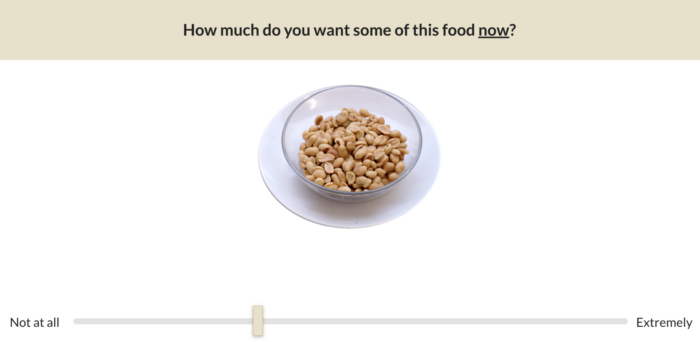
The LFPQ measures different components of food reward, separating how much people consciously “like” a food from their underlying, often less conscious “wanting” or motivation for it. Alongside it sits the Control of Eating Questionnaire (CoEQ), which captures experiences like food cravings and how much control someone feels they have over their eating. Both tools have built up substantial use in scientific and clinical research, including in trials of obesity drugs.
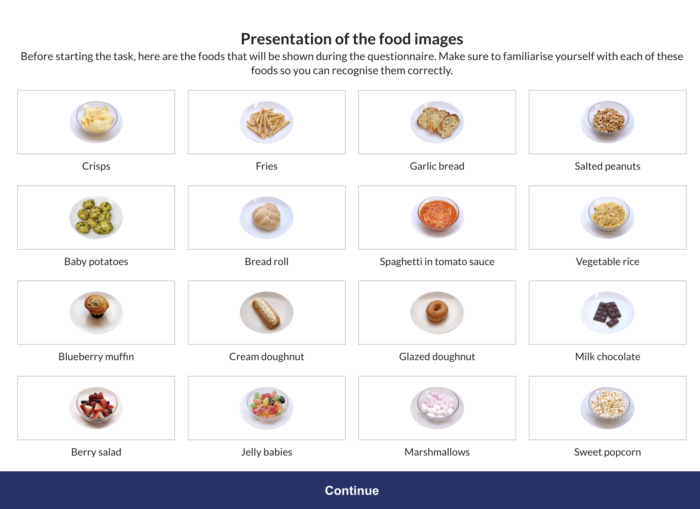
The trouble was infrastructure, not science. The LFPQ ran on fixed food-image sets and desktop software that made it difficult to deploy consistently across different countries, organisations and studies - a serious limitation for a tool increasingly used in international, multi-site pharmaceutical research. The IAA funding set out to close that gap: turning an established academic method into something scalable, flexible and commercially viable.
From prototype to platform
Working with software developer Regi.co.uk and the University’s commercialisation team, Finlayson’s group developed the existing LFPQ prototype into a multi-user web platform, with configurable languages and culturally appropriate food images, study configuration tools, participant management and data export. The team also worked through data protection requirements, scalability, and how results and visualisations should be presented to clinicians and participants - as well as producing guidance on reproducing the LFPQ correctly on other platforms, to preserve its scientific integrity when used by pharmaceutical companies and clinical research organisations.
The related CoEQ offered a useful proof of concept for the commercial model. It has been licensed to pharmaceutical companies and contract research organisations for use across obesity-treatment research, from early Phase 1 mechanistic studies through to Phase 3b trials - including semaglutide studies that used CoEQ alongside the LFPQ to track reductions in food craving and changes in high-fat food liking and wanting. That track record strengthened the case for giving the LFPQ a comparable, if more technically sophisticated, route to market.
Building on early momentum
The LFPQ has already been translated into more than 20 languages and is reported in use across more than 40 countries, with 219 approved non-commercial licences recorded since it was listed on the Leeds Licensing Platform. A 2026 evidence catalogue identified around 34 confirmed LFPQ publications, and a fuller scoping review currently in preparation has identified roughly 160 studies using the LFPQ as an outcome measure.
The IAA-funded work is now feeding into a larger next stage. A Follow-on Fund proposal has been developed to take the platform, LFPQ-2.0, from its current stage of development towards a production-grade, internationally deployable research tool - including formal equivalence and reliability testing, standardised localisation, integration with electronic data-capture systems, and multi-site feasibility studies. In parallel, the team is developing a CoEQ Regulatory Alignment Programme to strengthen CoEQ’s evidence base for use in obesity pharmacotherapy research, including patient-centred validation work and a clearer regulatory evidence package for pharmaceutical sponsors.
As Graham Finlayson puts it, Leeds has taken rigorous academic methods for measuring why people want, like and crave food, and begun turning them into practical tools for modern clinical and commercial research - with IAA funding providing the bridge between a proven scientific method and the infrastructure needed for it to be used at scale around the world.
This project was sponsored by the UKRI Impact Acceleration Account.