
Embedding evaluation to strengthen cultural investment

A strategic placement by the University of Leeds’ Centre for Cultural Value within Leeds City Council’s Culture Programmes Team has transformed how Leeds City Council thinks about and evaluates its cultural investments.
Drawing on a pragmatic, research-informed framework, this collaboration exemplifies how local authority ambitions can be empowered through university expertise, supporting better decision-making, more equitable funding, and stronger cultural ecosystems in a challenging funding climate.
Key information
- Major funders: UK Research and Innovation (UKRI), Arts and Humanities Research Council (AHRC), Arts Council England, Paul Hamlyn Foundation, University of Leeds, Esmée Fairbairn Foundation
- Partners and collaborators: Leeds City Council
- Disciplines: cultural engagement
- Investigators: Anna Kime, Professor Ben Walmsley.
Strategic collaboration in challenging times
There remains a postcode lottery in cultural provision across the UK, shaped by long-standing geographical, social, and economic inequalities. Cultural infrastructure and access can vary dramatically between local authorities, with profound implications for community wellbeing, inclusion, and economic opportunity.
In response, the Centre for Cultural Value at the University of Leeds is working to redress this imbalance. Through close collaboration with councils and sector partners, it provides tools and evidence to help make cultural investment more impactful and equitable.

One such partnership has taken root within Leeds City Council itself. Senior Policy and Partnerships Officer Pam Johnson explains the challenge: “We’re a small team with a huge agenda, so we’re always looking at ways to augment our capacity, skills and experience.”
To boost its cultural programme at a strategic level, the council engaged the Centre for Cultural Value, embedding researcher Anna Kime in the Culture Programmes Team for one day a week over a six-month placement. This model not only brought research closer to decision-making but also allowed both institutions to co-design solutions grounded in local realities and broader sector insight.
From ambition to action: building better evaluation practice
The collaboration was underpinned by a shared recognition: if cultural funding is to achieve the outcomes that matter most—to communities, practitioners, and policymakers alike, then robust, context-sensitive evaluation is essential.
Anna’s work focused on strengthening how the council understands and evidences the impact of its cultural investments. Many local authorities face similar challenges, balancing resource constraints with increasing pressure to justify spending. Anna’s approach brought a tailored, scalable solution to this problem.

Using the Centre’s wheel of change framework and its evaluation principles, Anna co-developed a pragmatic model for evaluation. Rather than imposing a top-down or overly complex structure, the methodology was cyclical, iterative, and sensitive to local needs. It began by aligning evaluation design with existing funding priorities and mapping a route from defined ambitions to baseline data collection in the first year of delivery.
This was not an evaluation for its own sake. It was about embedding reflective, achievable practices that could enhance strategy, support learning, and ultimately improve outcomes for Leeds’ cultural sector and residents.
“It was important that our investment programme kept pace with where the sector is—and where it needs to be. Evaluation is how we learn, adjust, and build stronger cases for future support.” – Culture Programmes Team, Leeds City Council
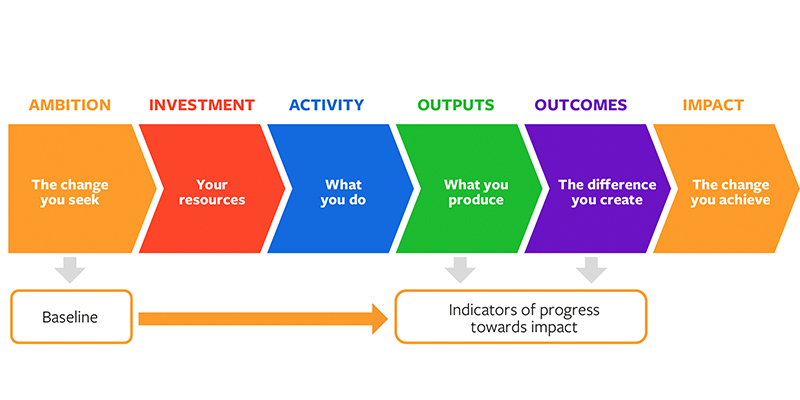
The wheel of change and key evaluation requirements
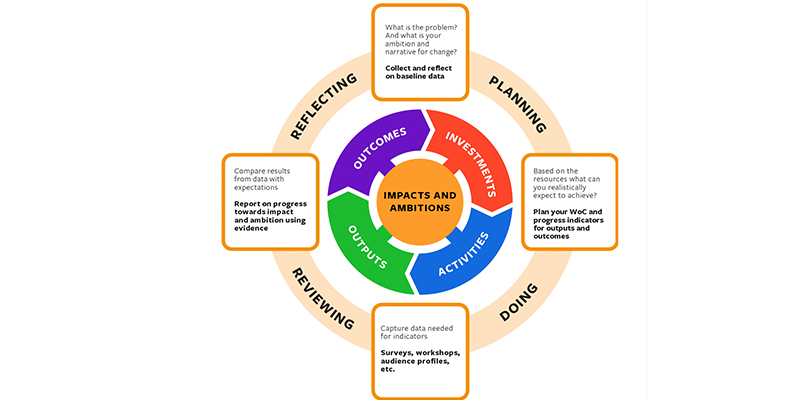
The Evaluation Learning Cycle (ELC) borrows from Action Research models that are frequently used in health and education to identify problems and what actions might be taken to improve practice. The basic Action Research Cycle has four stages: reflect on the problem; plan action; act and collect data; review, report and reflect.
Policy relevance at a national scale
The partnership also reflects growing momentum around cultural data at a national level. While the placement focused on Leeds, its implications go much further.
Anna’s colleague Professor Ben Walmsley is involved in the development of a national Cultural Data Observatory, designed to provide unified, accessible insights into the state and value of the UK’s cultural sector. Insights from Anna’s work are feeding into this parallel stream, showing how locally informed evaluation practices can enrich and be enriched by national infrastructure.

In this way, the placement not only addressed local needs but contributed directly to shaping future national policy tools. It demonstrated how academic partnerships can help local authorities respond in real-time to strategic challenges—while ensuring local knowledge is recognised on the broader policy landscape.
Strategic outcomes: local strength, national influence
This collaboration took place in a period of uncertainty. Cultural organisations continue to recover from the pandemic, public funding is under strain, and political change is reshaping priorities. In such a climate, clarity about what works, for whom, and in what conditions is more valuable than ever.
For Leeds City Council, the benefits were tangible:
- A clear, realistic evaluation framework tailored to their cultural investment programme
- Increased capacity to demonstrate impact and inform policy
- Greater confidence in aligning resources with community needs
For the Centre for Cultural Value and the University of Leeds, it reinforced the importance of strategic placement models in delivering civic impact—turning research into action and strengthening regional cultural leadership.

And for the broader cultural policy community, it offered a replicable example of how council university collaboration can drive better decisions, fairer funding, and stronger creative ecosystems.
This project also supports wider efforts led by Professor Ben Walmsley and the Centre to improve how cultural value is evidenced nationally. Building on learnings from Leeds, Ben is spearheading a national Cultural Data Observatory, a first-of-its-kind platform to support policymaking through robust, accessible cultural data.
Using Bradford City of Culture 2025 as a prototype case study, this work mirrors the Leeds collaboration in its ambition to create context-sensitive, scalable models for evaluation. Together, these initiatives demonstrate the University of Leeds' regional leadership and its national relevance in shaping the future of cultural policy.