
Laser technologies for precision surgery
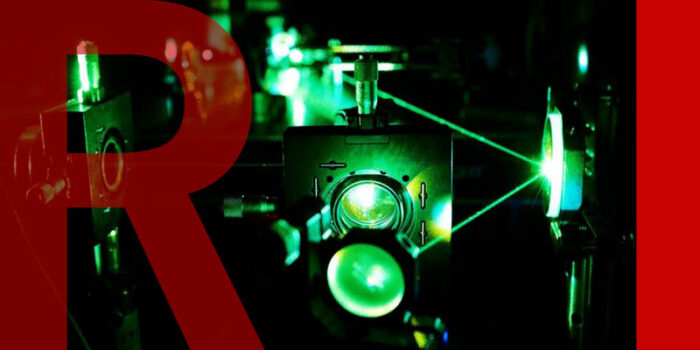
Research led by Professor Animesh Jha from the School of Chemical and Process Engineering contributes to the development of new laser technology.
In collaboration with the University of St Andrews and Glass Technology Services, the development of mode-locked lasers has applications in a variety of medical procedures such as restoring acid-eroded enamel, damaged soft tissue, and damaged bone.
Impact
- Worked with industry in a Knowledge Transfer Partnership to develop new laser technology with applications across medicine.
Key information
- Major funders: Engineering and Physical Sciences Research Council (EPSRC) Impact Acceleration Account (IAA), EU, Innovate UK, UK Technology Strategy Board
- Partners and collaborators: University of St Andrews, Glass Technology Services
- Disciplines: chemical and process engineering
- Investigators: Professor Animesh Jha, Dr Billy Richards.
Working with industry to advance laser technology
Professor Jha worked with the University of St Andrews and Glass Technology Services (GTS) to research special types of glass for advanced lasers, through a Knowledge Transfer Partnership (KTP).
Following the initial research, the collaboration brought on post-doctoral student Dr Billy Richards to complete a year-long secondment at GTS, during which he shared and gained knowledge about infrared-transmitting glasses. With market knowledge, the GTS group geared up the collaboration with industry partners and built manufacturing capability.
“As well as being able to pass on my knowledge to GTS, I learned a lot and thoroughly enjoyed my secondment,” Dr Richards said. “The industry links I gained were truly invaluable. I’ve also been able to continue the knowledge transfer within the university, as I’ve trained another three students in similar areas to continue the research.”
Since the collaboration, the University of Leeds spun out a manufacturing company, Vitritech Ltd, which will manufacture laser glass and related products.
Transforming the glass and laser industry
GTS has drawn on the success of the laser research projects with the University of Leeds to create a UK centre of high-tech glass research and manufacturing. The company is now working on a project to apply laser technology to improve existing glass-cutting techniques, which will transform glass processing capabilities across the industry.
The “Bright Slice” project, funded by a £93K grant from the UK’s innovation agency, the Technology Strategy Board, developed a novel glass-cutting technique using special lasers to improve the process of cutting flat glass substrates. It delivers a cleaner, safer, more cost-effective process, which has the potential to be applied across several other sectors – such as glass fibres, photonics, solar panels and tableware.
The success of the funded laser projects has enabled Professor Jha and his team to engage with larger research networks of industry and academia, facilitating a very high standard of PhD and postdoctoral staff training.
Medical applications
Professor Jha, with the laser teams at St Andrews University and the University of Leeds School of Dentistry, discovered that groundbreaking laser technology could be developed for use in regenerative medicine.
The team worked on an emerging issue in oral health – acid-eroded enamel. This is a lifestyle symptom which is prevalent at all ages, and there is no cure. Toothpastes in supermarkets and pharmacies provide symptomatic relief but don't permanently fix the enamel.
Professor Jha and his team formulated materials for restoring the enamel surface using the developed lasers. The technique brings together the power-controlled mode-locked laser and novel materials onto the damaged surface and restores the exposed dentine with the acid-resistant enamel material. This is a paradigm shift in laser-based precision surgery which opens new opportunities for patient care.
“It’s a bit like plastering a wall,” Professor Jha explained. “You fix the cracks in the wall surface with the plaster, which then becomes part of the wall. The synthetic material is actually more acid-erosion-resistant than natural tooth enamel, so once it’s fixed into place in the patient’s mouth with the laser, we will make their teeth stronger and cure the problem. Mode-locked lasers carry powerful packets of energy, but they’re being delivered in a way that doesn’t cause damage to the surrounding healthy tissue.”
The Leeds-St Andrew's team and its industry partners have developed a medical device which uses a compact form of laser. The laser maintenance and operation cost is considered in the design, making the medical device cost affordable for use in clinics and hospitals.
He explained: “If you can make devices affordable, it can reach a much wider application space from small surgeries to hospitals. That’s very important.”
Professor Jha’s work in advanced lasers and synthetic tissue manufacturing is leading to further medical applications such as treating gum disease, developing synthetic bone material and diagnosing bowel disease.
Professor Jha explained: “There’s a plethora of applications for surgery. We have a very difficult journey ahead of us, but it’s a learning experience. We must learn and fix it, then move to the next problem – this is how I see it as an engineer.”
This project was sponsored by the UKRI Impact Acceleration Account.