
Saving vital food crops by identifying genetic targets

When she left Cuba in 1994, Professor Yoselin Benitez-Alfonso said goodbye to a country in turmoil, unsure of where her future might lie. Today, she’s leading a team of researchers in a bid to take advantage of long-misunderstood aspects in plant biology with the aim of driving sustainability forward.
Yoselin’s journey began in Spain, where she investigated fungal infections in olive trees. Her passion for plant biology led her to Leeds, where her team is uncovering ways to fortify crops against disease, extend fruit shelf life, and develop sustainable biomaterials. By bridging molecular biology and agricultural innovation, her work holds the potential to revolutionise global food security in the face of climate change.
Impact
- Advancing crop resilience: the research on plasmodesmata is uncovering ways to enhance plant resistance to fungal infections, drought, and environmental stress, helping to secure global food supplies
- Reducing food waste: discoveries related to fruit ripening and spoilage prevention could extend shelf life and improve food quality, reducing food waste and enhancing sustainability
- Bridging science and agriculture: by integrating molecular biology with agricultural innovation, the research offers practical applications for improving crop yield and resilience in the face of climate change
- Potential for sustainable materials: the study’s insights into plant cell communication may lead to new biomaterials, such as bioplastics, offering eco-friendly alternatives in manufacturing and packaging
Key information
- Major funders: UK Research and Innovation
- Partners and collaborators: Black in Plant Science UK, Angus Soft Fruits, Futamura UK
- Disciplines: biology, biomechanics, biotechnology.
- Investigators: Professor Yoselin Benitez-Alfonso with support from Professor Michael Ries and Dr Simon Connell.
The friend and the foe
You might think the loss of some crops to disease is no big deal; a necessary side-effect of growing the food the world needs.
But with the United Nations predicting a global population increase of nearly two billion people in the next 30 years, the challenge for those in agriculture and food production is to reduce the level of attrition as much as possible.
Despite the widespread use of antifungals, between 10 and 23 per cent of crops are lost to fungal infection every year – meaning we waste enough rice, wheat, maize, soya beans and potatoes to feed at least 600 million people with 2,000 calories every day for a year.
On the other hand, exploiting symbiosis with beneficial microbes such as rhizobia and arbuscular mycorrhiza fungi could improve the efficiency of our crop management therefore offers opportunities to achieve greater production, boost food security and address future world hunger.

Professor Yoselin Benitez-Alfonso
For plant scientists like Professor Yoselin Benitez-Alfonso in the School of Biology here at The University of Leeds, some of the answers to these questions lies in the fundamental understanding of plant signalling mechanisms and their function in regulating plant growth and environmental resilience.
She and her colleagues are working on a UK Research and Innovation-funded Future Leader’s project dissecting the role of microscopic pores connecting plant cells named plasmodesmata in plant development and responses to environmental stresses.
A European future
Excelling in undergraduate Chemistry at the University of Córdoba earned Benitez-Alfonso a scholarship that allowed her to embark on a PhD in Biochemistry and Molecular Biology – but it was never going to be straightforward.
“I didn’t have a degree in Biology, so I had to teach myself plant biology and learn from my supervisors and peers – but it kickstarted a love affair with plants,” she recalled.
During her PhD, Yoselin focused on the interaction between olive tree and a fungal pathogen called Spilocaea oleaginea that produce the so-called ‘olive peacock spot’ disease.
During her studies, she discovered how plant cells communicate with each other to respond to their environment – and how viruses have evolved to exploit this process to spread themselves. This captured Yoselin’s imagination and was the topic she followed on her first postdoctoral research placement at Cold Spring Harbor Laboratory in New York, USA.
Driven by a quest for answers
“It frustrated me,” she remembered.
“I’m a very inquisitive person, so when I realised that some plants were getting infected but others were not, I wanted to know why.
“I could tell that it was something that was genetically determined, but I couldn’t work out how from the higher level of biochemistry that I was doing.”
The interest of discovering how plant cells communicate and concert responses to environmental cues led Yoselin from Spain to USA and then to UK, first to the John Innes Centre in Norwich and then to Leeds. In both, US and UK labs, she researched plasmodesmata as one of the mechanisms that plant uses to transmit signals from one cell to their neighbours enabling intercellular and inter-organ communication. At Leeds, she now leads a project seeking to a greater understanding of this topic and their future translation into potentially huge real-world benefits.
Making the most of modern advances
Never heard of plasmodesmata?
You’re not alone.
Plasmodesmata are microscopic channels that act like pores across the cell walls of plant cells, enabling transport and cytoplasm-to-cytoplasm communication between them.
Think of them like an underground subway network, only instead of taking busy commuters from one side of a city to another, they let nutrients, proteins and signals through to adjacent plant cells.
But while they might perform a crucial role, in biological terms, they’re still remarkably understudied.
“It’s only with the advent of new technologies and new developments in old techniques like electron microscopy that we’ve been able to learn more about them,” Yoselin said.
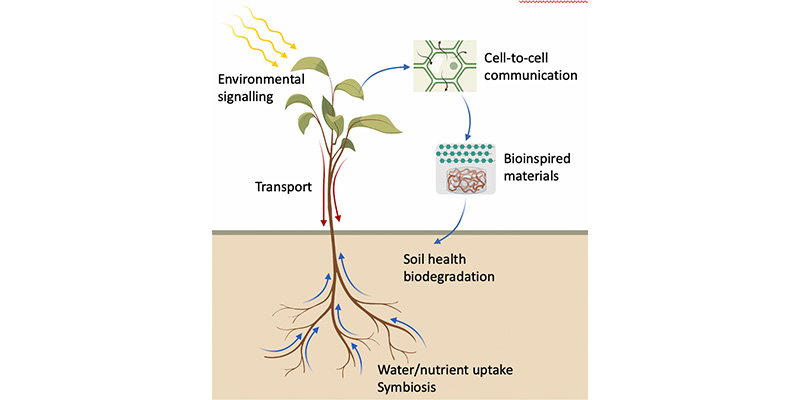
Molecular signals are transported between cells and across the whole plant body to control growth and responses to changes in the environment. The Benitez-Alfonso lab research cell walls and plasmodesmata as targets for improving plant growth and the design of recyclable biomaterials.
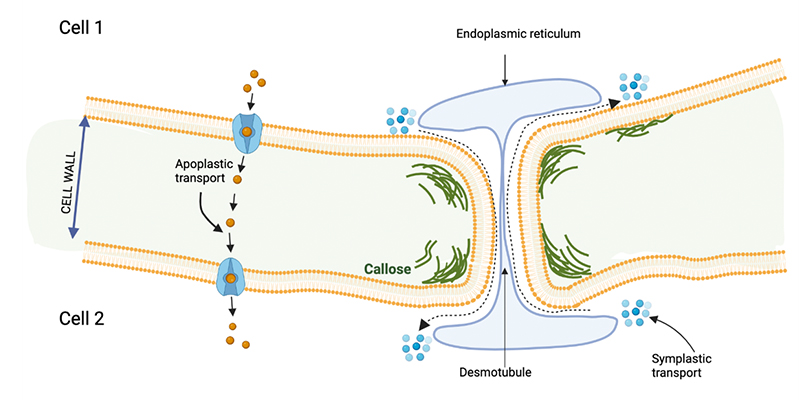
Plasmodesmata are membrane pores that traverse cell walls to connect the cytoplasm and the endoplasmic reticulum of neighbouring cells, enabling molecular transport..
Long known, little understood
The botanist Eduard Tangl may have discovered plasmodesmata in 1897, but for the best part of a century, they were mistakenly seen as simple holes responsible only for mediating the passive diffusion of small molecules.
Only during the last few decades have scientists come to realise the true nature of these essential structures – and the threats they can inadvertently pose to the plants that rely on them.
“Viruses have evolved to exploit these channels and use them to spread from cell to cell, but they are also essential for the signalling cues that concert plant growth” Yoselin explained.
“So what we are trying to do in this project is to analyse the mechanical properties of cell wall components that affect how the plasmodesmata functions.”
“By doing that, we will identify genes and cell components that we can target to modify intercellular communication, plant growth and environmental resilience.”

From theory to application
The team is on a mission to understand still somewhat mysterious natural phenomena and use the findings to give nature a helping hand, at least on the side of climate-resilient and nutritious crops.
And their research is already bearing fruit.
“We are still experimenting, but we’ve already had some breakthroughs,” Yoselin said.
“We’ve identified the differential regulation of a cell wall component at plasmodesmata using monoclonal antibodies during fruit ripening. Applications of this knowledge could help to reduce or delay fruit spoilage, improving their shelf life while increasing sugar content.
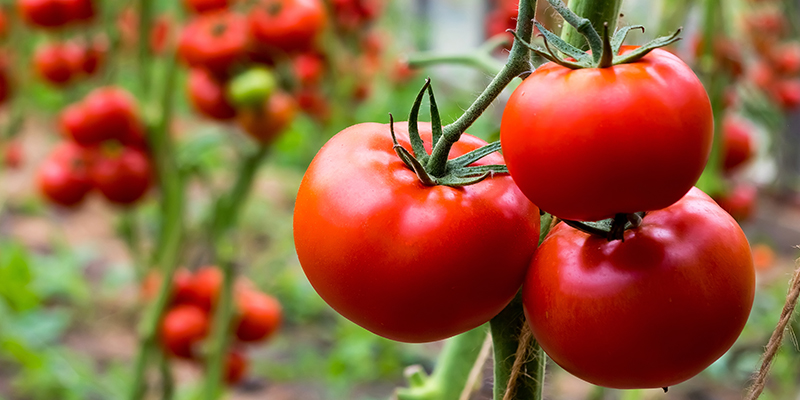
“Plus, we’ve made some discoveries around how plasmodesmata responds to drought and temperature stress – all very relevant when you think about the threats posed to crops by climate change.”

Leaf surface with stomata imaged with light microscopy.
Inspiring the next generation
Since joining Leeds in 2013, Yoselin has progressed from her role as a lecturer and academic fellow to become Professor of Interdisciplinary Plant Science 10 years later.
The appointment made her only the 66th black female professor in the UK – a remarkably underrepresented demographic, given around 23,000 professors are working in the country in total.

Professor Yoselin Benitez-Alfonso
In fact, Professor Benitez-Alfonso co-founded the Black in Plant Science UK network to connect and celebrate diversity in her field.
Looking forward, Yoselin believes that by further unravelling the properties of plasmodesmata, we will find numerous applications in crop sciences, packaging and nutrition that could help us live more sustainably.
And with the planet facing the growing threats of rising temperatures and sea levels, the race is on.
An exciting future
“By working across disciplines here at Leeds, with colleagues across Europe, Asia and the USA and with our partners in industry, we will help make crops more resistant to climate change and better able to deal with depleted soils so that the food supply can stay strong even in long periods of bad weather.
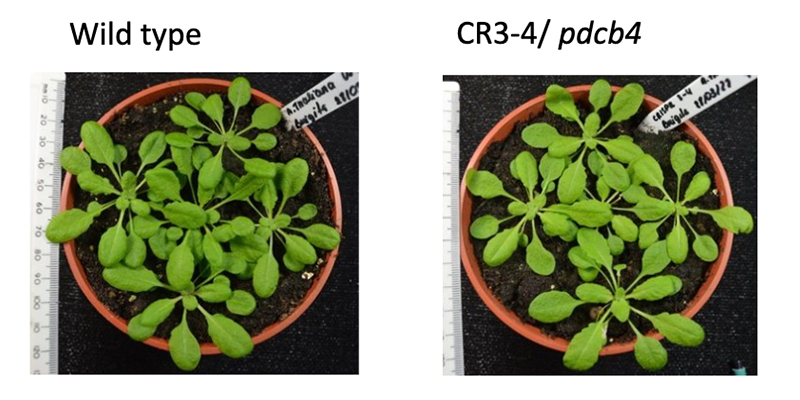
Mutant plants in a plasmodesmata protein (PDCB4, right) regulate responses to drought and display subtle phenotypic differences to control wild type plants (left).
“We’re also looking at how unused plant resources could be repurposed to become new biomaterials like bioplastics, giving us eco-friendly alternatives in the manufacturing process.”
Research into plasmodesmata may still be in its relative infancy.
But for Yoselin, her colleagues and her current and future project partners, that just means plenty of untapped plant potential.
Professor Yoselin Benitez-Alfonso
Yoselin is a Professor of Interdisciplinary Plant Science in the School of Biology.
She joined the University in 2013, having previously been a postdoctoral researcher at the John Innes Centre in Norwich and, before that, the Cold Spring Harbor Laboratory in New York.
Yoselin’s areas of expertise include cell-to-cell signalling, plasmodesmata regulation, plant development and environmental resilience, physical and biological properties of cell wall polymers, and biomaterials.
You can repost this article following the terms listed under the Creative Commons Attribution-NonCommercial-NoDerivatives 4.0 International licence.
The views expressed in this article are those of the author and may not reflect the views of the University of Leeds.
Keywords: climate change mitigation and adaptation